
Introduction
IoT systems for effective functioning is based on the well-organized architecture that provides data collection, transmission, processing and visualization.
IoT architecture levels
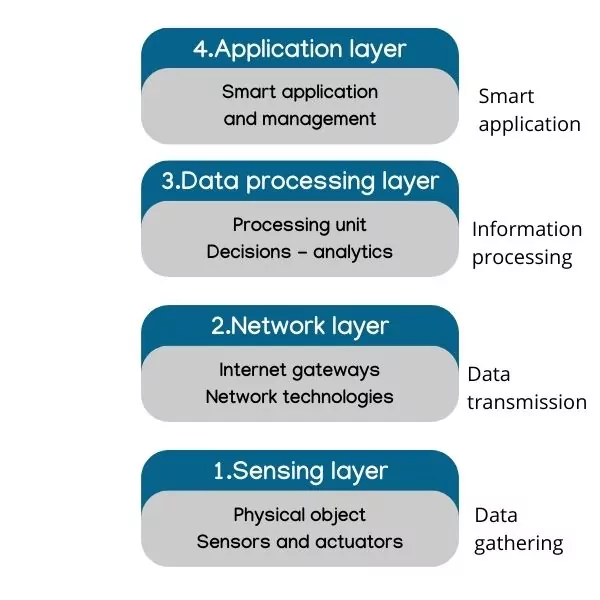
IoT system usually consists of several layers:
1. Perception layer (Perception Layer)
this layer of placed sensors and actuators that collect data from the environment (temperature, humidity, movement, etc.Etc.).
2. Network layer (Network Layer)
in this stage, the data transmission through the internet or other communication protocols by means of (Wi-Fi, Bluetooth, 4G/5G).
3. Processing layer (Processing Layer)
here data is stored, processed and analyses cloud systems or servers.
4. Application layer (Application Layer)
this layer gives the user the opportunity to see and manage data from different interface (mobile app, web app).
Working principle
IoT system, the process begins with sensors collecting data, then this data is transferred to the network, is sent to the server, processed, and finally to customers in visual form. If necessary, the system will automatically perform a particular action (for example, temperature regulation).
Example in practice
Smart thermostat collects temperature data, sends them to a cloud platform, where the analysis and, consequently, to automatically regulate heating systems.
To summarize the table
| Layer | Function |
|---|---|
| Perception | Data collection |
| Network | Data transfer |
| Processing | Analysis and storage |
| Application | User interface |